updated 4/24/23
Just some general notes from driving electrified vehicles I’ve owned
Hybrid — Ford Maverick
- Electrified driving operates at low speeds/revs
- When coasting or sitting still, no fuel is used, meaning no emmissions
- If battery runs out of juice, gas engine will kick in
- Never needs to be charged by person, will charge via driving or gas engine
- 2‑levels of braking: regenerative and physical
- Battery recharges with either coasting or regenerative braking
- Initial thought was that hybrid would be great for sitting in commuter traffic. However, it would only be good in suburb traffic or light traffic where lots of coasting is possible. Heavy traffic (where there is a lot of small, quick bursts of acceleration) is NOT the best for relying on pure electric driving
- Initial electric power is high torque, so smashing accelerator off a stop is impressive and fast (dependent on overall power)
- Hauling heavy items in trunk is also impressive in the Maverick where the hybrid power is very helpful
- Highway driving is surprisingly efficient. Ended up with about 20% of highway trip miles electrified
- Better driving habits yield better efficiency
- Cut gas consumption in half compared to prior pure-gasoline cars
- More efficient in cities than rural driving, but still cuts reliance on gasoline
- Just uses gas, no need to charge
- Maintenance: Need oil change, fluid flushes, and other maintenance like pure gasoline cars…but possibly at lesser intervals
- Best driving technique: Feather the accelerator. Just keep tapping it enough at the lowest revs to utilize the electric driving in order to keep the car moving while not jumping into the gasoline consumption. All good-driving rules will increase MPGs
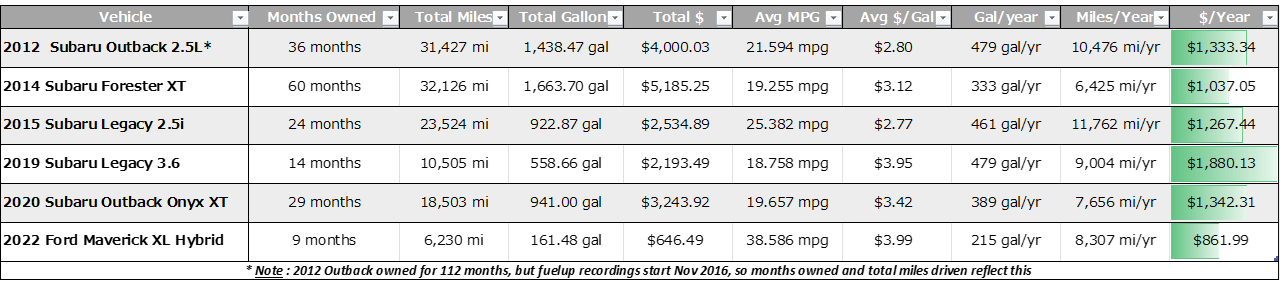
1 year driving (January through January) Stats for 2022 Ford Maverick
- Total Running Costs: $2,997.52
- Running Cost per day: $6.56
- Running Cost per mile: $0.37
- Distance per day: 18 miles
- Total Miles Driven: 8,050.6 miles
- Total Time: 1 year
- Average MPG: 38.213 (Min: 31.5; Max: 43.6)
- Average Price per Gallon Gasoline: $3.83
- Average Price per Fuelup: $26.72
- Average Fuelup Quantity: 7.01 gallons
- Miles per Fuelup: 266 miles
- Days per Fuelup: 12 days
- Total Service Cost: $2,222.59
Battery Electric Vehicle — Ford Mustang Mach‑E
- Smooth, silent drive
- 2 levels of braking: regenerative and physical
- Option for 1‑pedal driving
- 3 driving modes: Whisper (low accelerator response, extended coasting, minor regeneration), Engage (moderate acceleration and braking, regenerative braking), Unbridled (high acceleration sensitivity, responsive braking, high regenerative braking– halfway between regular driving and 1‑pedal)
- HVAC usage is big drain on battery consumption
- High torque –> high acceleration
- Heavier load –> higher battery usage
- Hard acceleration quickly drains battery
- Electronics use only a fraction of battery
- When not moving, no power used
- Fantastic for heavy traffic and heavy braking (equals more regeneration, less power usage)
- Good driving habits yield better efficiency
- In cold weather, driving faster might mean better efficiency (have to evaluate data more)
- No tailpipe emissions
- Minimal noise pollution
- My usage is about 50kWh a week. That’s 200kWh a month (for comparison an average household uses 877kWh a month in 2019). That’s $30 a month in fuel costs if price is $0.15 per kWh like mine residential
- Maintenance: No oil, no belts, no fluids to maintain. Required for wheels, tires, and brakes
90 Day Driving (January through April) Stats for 2023 Ford Mustang Mach‑E
- Total Running Costs: $84.71
- Running Cost per day: $0.94
- Running Cost per mile: $0.06
- Distance per day: 17 miles
- Total Miles Driven: 1,517 miles
- Total Time: 90 days
- Average MPGe (Fuel): 95 (Min: 78; Max: 114; ADJ: 108)
- Average MPGe (Trip): 96 (Min: 30; Max: 172; ADJ: 119)
- Average Price per kWh: $0.14
- Average Price per Fuelup: $3.39
- Average Fuelup Quantity: 29 kWh
- Average Miles per Fuelup: 64 miles
- Average Days per Fuelup: 3 days
- Total Service Cost: $0.00
Trip Comparison
Trip: A to B to C to D (same exact destinations, same exact route, same driving mode)
March 20th (40F and windy cold): 39% to 34% to 31% to 30% = 9% charge used
May 8th (76F and humid): 36% to 35% to 34% to 33% = 3% charge used